Skip to content
AdobeStock_274931064 (1) 1319 x 530 USE

SEISMIC DAMPING SYSTEMS FOR U.S. NEW BUILDS & RETROFIT

TECTONUS IN USA - AT A GLANCE

US structural engineers are steadily adopting Tectonus technology as engineering and delivery proof accumulates. 

  • HCAI approval. Prototype testing of the DMAX brace qualified it for use in a California hospital retrofit.

  • Major hospital retrofit. Tectonus braces have been specified for a major hospital retrofit project due to start in 2027.
  • Oakland projects. Two retrofit projects were approved by Oakland Building Dept; one has been completed. 
  • Partnered with Herrick Steel. To promote alternative structural solutions, Herrick took a strategic stake in the business.   

Tectonus is working with leading engineering firms on retrofit of existing buildings, cutting-edge mass timber structures, and risk category IV buildings where functional recovery is a design driver. 

North American firms with Tectonus design experience

WHAT DRIVES SPECIFICATION?

US structural engineers tend to consider Tectonus in one of two situations:

  • Economy. Some combination of poor soils, high seismicity, irregular load paths, and high risk category create an opportunity for Tectonus' system to reduce total system cost, typically by reducing demand (through high damping and low overstrength) on the structure and/or foundations. 

  • Functional Recovery. Post earthquake operability is the primary driver and Tectonus' system can manage drifts economically and keep residual drift almost to zero, thereby limiting damage to the structure. 

Since Tectonus is an alternative system, there has to be significant value-add over the conventional design, and the schedule needs to accommodate additional analysis and peer review.

SYSTEM OPTIONS

Match the System to the Objective

Different projects have different seismic performance objectives. Some prioritise reducing seismic demand and structural weight, while others focus on minimising damage, improving resilience, or simplifying retrofit construction. Tectonus has a range of seismic damping solutions that can be matched to the performance goals of a project.
DMAX Forte 325 x 257

TECTONUS DMAX

BRB/EBF alternative with low overstrength

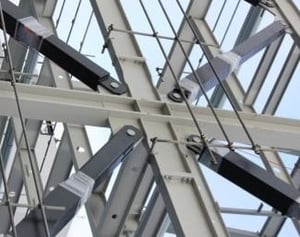
A friction-damped structural brace that provides high energy dissipation with low overstrength demand.

Often used for:

  • Steel braced frame buildings
  • BRB / EBF replacement
  • Commercial buildings
  • Seismic retrofits

Why engineers consider DMAX:

  • High hysteretic damping
  • Reduced force demand on supporting elements
  • Lower overstrength compared with conventional yielding systems
  • Familiar design approach for engineers experienced with braced frames
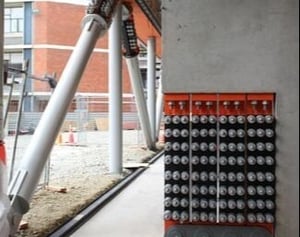
Tectonus devices-1

TECTONUS RSFJ

Self-centering seismic braces hold downs

A friction-based connection that combines energy dissipation with self-centring behaviour.

Often used for:

  • Critical (post-disaster) infrastructure
  • Mass timber structures
  • Low-damage seismic design
  • Rocking structural systems

Why engineers consider RSFJ:

  • Reduces residual drift after earthquakes
  • Enables self-centring structural behaviour
  • Provides repeatable energy dissipation
  • Supports resilient building design without structural yielding
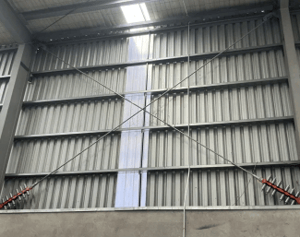
XBrace 325 x 257

TECTONUS XBRACE

Tension-only braces with 3x more ductility

A damped tension-only bracing system designed for efficient seismic strengthening and new construction.

Often used for:

  • Industrial buildings
  • Warehouses
  • Low-rise steel structures
  • Retrofit projects

Why engineers consider XBRACE:

  • Lightweight and simple to install
  • Improves seismic energy dissipation
  • Can reduce seismic demand on foundations
  • Supports efficient steel bracing layouts


DESIGN EXAMPLE

Pacific NW Datacenter

The impact of overstrength can be seen in this 135,000 sq ft datacetner in the Pacific North West. For speed and simplicity of comparison the same ductility was applied for both systems. 

Conventional BRB Tectonus DMAX
R = 8 R = 8
Max drift <2% Max drift <2%
Overstrength ~2.0 Overstrength ~1.15
Max brace force 1918 kips Max brace force 1103 kips

In this case, the maximum brace force reduction resulted in a 43% reduction in structural steel weight. 

CASE STUDY - OAKLAND WAREHOUSE RETROFIT

This voluntary retrofit introduced 32 friction-based energy dissipation devices as knee braces supporting the existing truss frames, improving seismic performance while limiting extensive structural strengthening and foundation intervention. 
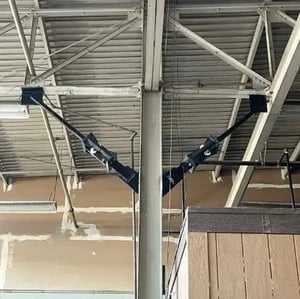
92nd Ave Oakland CA as installed 400 x 400 USE

Designing with Tectonus in the United States

As an alternative system, designing with Tectonus requires additional modelling and analysis and peer review. 

US engineers have designed according to ASCE-41 and gained approval with HCAI and Oakland Building Dept.  Depending on the application, ASCE 7, ASCE 41, performance-based design, alternative-means approval, testing and peer review may form part of the pathway.

Tectonus works with the engineer of record on device properties, modeling assumptions and supporting technical documentation. Preliminary design and modeling parameters for ETABS, SAP2000 and Perform3D are available in the relevant product design guides.

If you have a project in mind - let one of our technical experts review it with you.

PERFORMANCE TESTING

Tectonus systems are supported by component, system and full-scale testing.

For HCAI approval, 20 devices from 45-180 kips were tested at Lehigh University in Pennsylvania, including 2,000-cycle wind loading and large-displacement cyclic testing.

Please note: every single device is individually tested to the engineer's specification before shipment.

Monitor image for Tectonus US page (1)
support placeholder image

How can we help?

Get in touch to ask a Tectonus engineer about your project or schedule a free consultation