
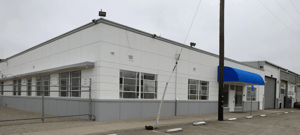
Steel Truss Retrofit
Project Overview
The building at 850 92nd Avenue is a single-storey industrial warehouse constructed with long-span steel roof trusses supported by steel moment frames. Structures of this type are common throughout the San Francisco Bay Area. Many exhibit limited ductility and weak connection details, making them vulnerable to damage during major seismic events.
The retrofit strategy focused on improving system-level seismic performance by adding energy dissipation capacity, rather than strengthening every structural element. The scope of work included installing 32 friction-based energy dissipation devices integrated into the existing moment frame system as 'knee braces' (aka 'haunch braces').
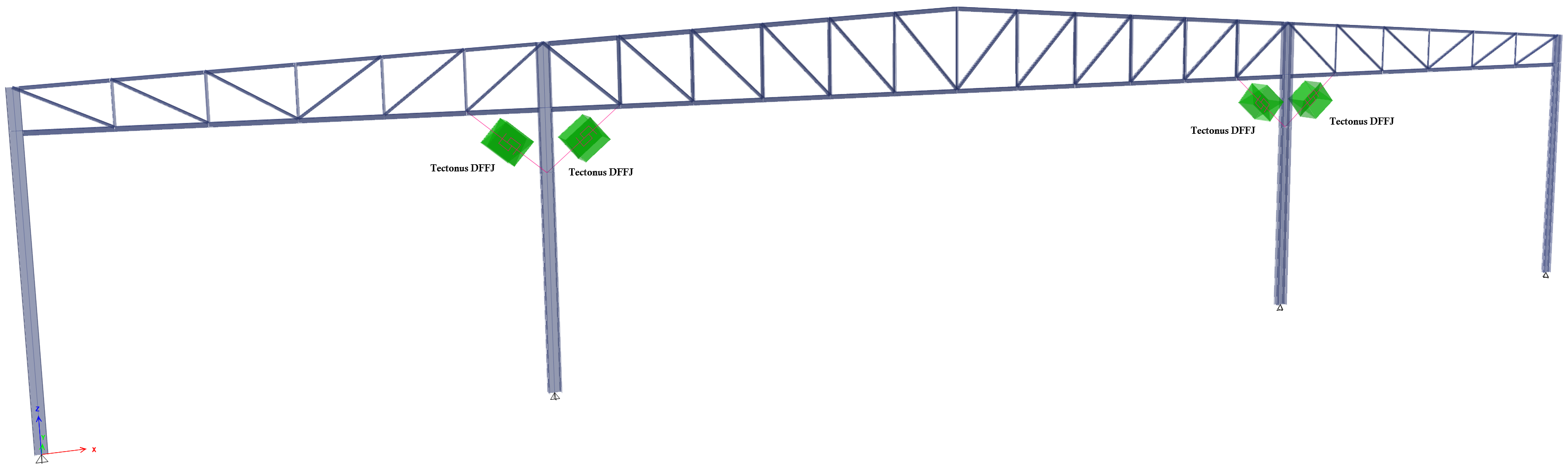
Simple extrusion of truss frame in Etabs Building Design Software.
This project demonstrates a voluntary seismic retrofit using energy dissipation devices applied to an existing industrial warehouse in Oakland, California. The retrofit integrates friction-based dampers into the existing steel moment frame system to improve seismic performance while avoiding extensive structural strengthening.
This project represents one of the first deployments of Tectonus damping technology in the United States, approved by the City of Oakland. Construction was completed mid-2025. The retrofit demonstrates how friction-based energy dissipation devices can be integrated into existing steel frame buildings to improve seismic performance while avoiding extensive structural strengthening or foundation upgrades.
Seismic Hazard Context
The Oakland site is located in a high seismic hazard region near the Hayward Fault system.
Hazard parameters derived from the ATC Hazards by Location database indicate:
|
Parameter |
Value |
|
Site Class |
D |
|
BSE-1E Spectral Acceleration (0.2s) |
1.105 g |
|
BSE-1E Spectral Acceleration (1.0s) |
0.683 g |
These values reflect the high seismic demand typical of Bay Area industrial structures and informed the retrofit design criteria.
Compliance pathway
The project followed a voluntary seismic retrofit approach using energy dissipation devices under the 2022 California Building Code (CBC).
Specifically:
- CBC 2022 Section 503.13 – voluntary lateral system alteration
- Engineering standard: ASCE 41-17
- Analysis procedure: Tier 3 Nonlinear Static Procedure (pushover analysis)
This pathway allowed the design team to improve seismic performance without triggering full building compliance upgrades, which can be prohibitively expensive for existing industrial facilities.
The retrofit is therefore focused on enhancing the performance of the primary lateral system, rather than bringing every building element into full compliance with current new-build standards.
Structural System
Existing System
The building’s lateral force-resisting system consists of:
- Steel moment frames supporting long-span roof trusses
- Steel columns including W8x18 and W10x33 sections
- Steel truss chords formed from double angles
- Braced bays and rod bracing in selected locations
The roof structure spans approximately 360 ft across the building plan with repetitive truss framing.
While the system provides gravity load capacity, its seismic performance is constrained by:
- Limited ductility in connections
- Relatively flexible long-span trusses
- Potential foundation limitations
Design Strategy for Voluntary Seismic Retrofit Using Energy Dissipation Devices
Instead of strengthening the entire frame, the design team introduced friction-based Energy Dissipation Devices (EDD) into the existing truss moment frames.
These devices:
- Install within new brace assemblies
- Connect to the existing steel framing via gusset and clevis plates
- Dissipate seismic energy through controlled friction slip
The dampers are installed at moment frame locations along grid lines A through H, improving the building’s lateral response.
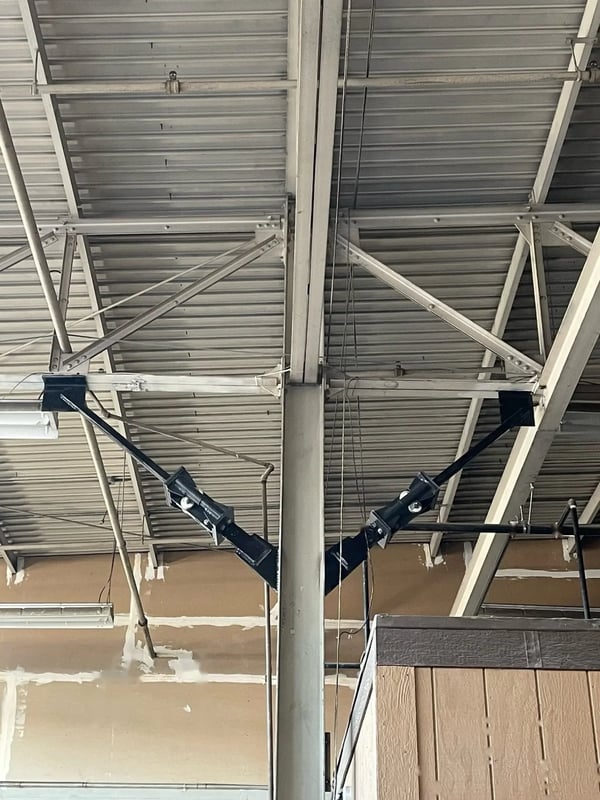
Installed images showing simple knee braces connecting from columns to the truss bottom chord.
Performance Verification
Testing included cyclic displacement protocols with increasing amplitudes:
|
Test |
Displacement |
Cycles |
|
Test 1 |
0.375 in |
10 |
|
Test 2 |
0.75 in |
5 |
|
Test 3 |
1.125 in |
3 |
This testing program confirmed the repeatable hysteretic behavior and stable damping response required for seismic applications.
Constructability Advantages
A key design objective was to minimize disruption to the existing structure and ongoing operations.
Advantages of the retrofit approach included:
- Installation within existing steel frames
- Minimal modifications to foundations
- Limited strengthening of existing truss members
- Bolted connections for rapid installation
This approach enables significant improvements in seismic performance with a relatively targeted structural intervention.
“The use of energy dissipation devices provided a practical way to improve the building’s seismic performance within the constraints of an existing structure, without requiring extensive strengthening of the primary system.”
Aaron Malatesta, Senior Engineer - J.S. Held
Project Outcomes
The retrofit strategy provides several benefits:
Improved seismic resilience
Energy dissipation reduces seismic demand on the existing frame, improving the building’s ability to withstand major earthquakes.
Reduced structural strengthening
By adding damping, the design avoids extensive upgrades to columns, diaphragms, or foundations.
Cost-effective compliance pathway
The voluntary retrofit pathway allows owners to improve performance without triggering full CBC upgrade requirements.
Scalable retrofit approach
Many Bay Area industrial buildings share similar structural characteristics, making this approach applicable to a large portion of the existing building stock.
Key Takeaways for Structural Engineers
This project demonstrates how energy dissipation devices can be integrated into existing steel frame structures using an ASCE 41 performance-based retrofit strategy.
For buildings where foundation upgrades or major strengthening are cost prohibitive, friction-based damping provides a practical way to:
- Reduce seismic demand
- Improve ductility
- Enhance system-level performance
- Maintain constructability within existing structural constraints

How can we help?
Get in touch to ask a question or schedule a free consultation
