Skip to content
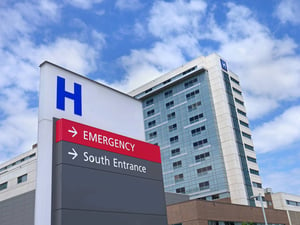
Hospital hero image

CRITICAL INFRASTRUCTURE

Many critical infrastructure projects aspire to higher levels of post-quake functionality. Base isolation, still the gold-standard for seismic resilience, may introduce cost, programme, architectural, or site constraints that make adoption difficult.

Tectonus provides an alternative path: advanced low-damage seismic technology that helps critical facilities remain operational after major earthquakes while remaining practical to design and compatible with core construction workflows. 

When Base Isolation is Difficult to Justify

Base isolation remains the gold standard for excellent seismic performance, but it is not always practical or achievable within real-world project constraints.

Projects may encounter challenges such as:

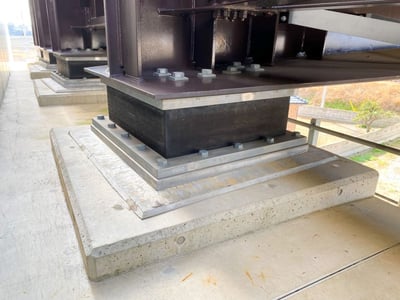
  • Cost Pressure: Additional structural,Base isolator foundation, and construction costs can exceed available budgets.
  • Site Limitations:  Poor ground conditions, flood requirements, or existing infrastructure can complicate isolation systems. 
  • Architectural Constraints: Separation gaps, movement allowances, and service detailing may conflict with project requirements.
  • Programme Complexity: Isolation systems can increase procurement coordination, consenting complexity, and construction sequencing risk.
  • Retrofit Challenges: Introducing isolation into existing operation facilities is often highly disruptive. 

For many projects, the challenge is not whether resilience is important - it is how to achieve meaningful performance improvement within practical delivery constraints.

Controlling Residual Drift - Within the Superstructure

In response to these challenges, industry has sought ways to control residual drift within the structure itself. A common strategy is pairing supplemental damping systems with a separate structural system intended to provide restoring force.

Examples include:

  • Viscous dampers with moment frames
  • Rocking shear walls with post-tensioning
  • Supplemental damping with braced frames

While effective, these systems often introduce additional project complexity because performance depends on the interaction between multiple structural mechanisms. 

  • More complex analysis and modelling

  • Increased detailing and coordination requirements

  • Greater interface management between systems

  • Additional architectural and construction integration demands

  • More complicated retrofit implementation

  • Increased procurement and sequencing complexity

By combining energy dissipation and re-centering into one compact system, Tectonus offers an alternative intended to minimize some of these headaches.  

TECTONUS APPROACH

A Practical Alternative for Low-Damage Seismic Performance

Tectonus devices are designed to reduce  damaging seismic demands while remaining simpler and more practical to integrate than base isolation and dual systems. 
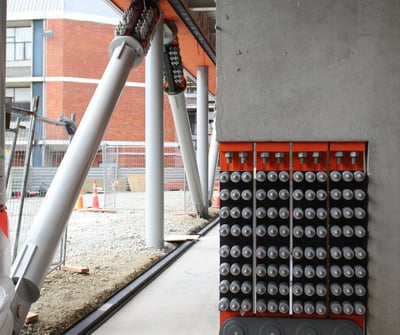
Tectonus devices

By combining controlled movement with self-centering behaviour and energy dissipation into one compact device, Tectonus offers engineers a way to manage residual drift, limit structural damage, and improve post-earthquake functionality - without requiring the full architectural and foundation implications associated with base isolation or some of the integration challenges associated with dual systems. 

Minimise residual drift
Limit structural damage
Maximise functional recovery
Align with standard construction workflows
APPLICABLE INDUSTRIES
Emergency response
Healthcare buildings
Data centers
Utilities infrastructure
Transport hubs
Civil defence facilities
Defence and security
Industrial facilities

FEATURED PRODUCTS

F+E Home Office 600 x 450

TECTONUS HOLD DOWNS

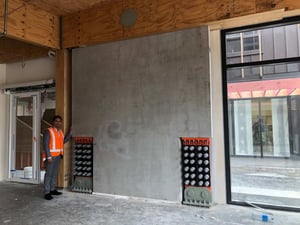
Hold downs for concrete and timber shear walls


Greys ave tension only upper

TECTONUS XBRACE

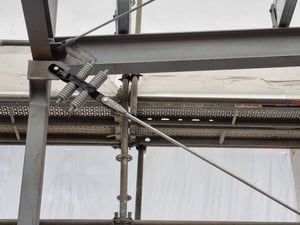
Tension-only braces for lightweight buildings


Lincoln_5392-retouch 600 x 450

TECTONUS RSFJ BRACE

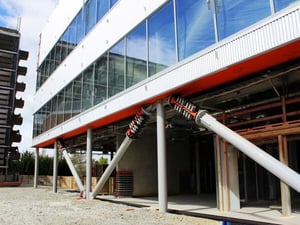
Recentering braces for braced frame buildings


"We were interested in adopting new technology that would both reduce potential future earthquake damage but also allow the space to be re-occupied much faster than might be the case in a more conventionally designed building"

Wayne LawsonProject Manager, Lincoln University

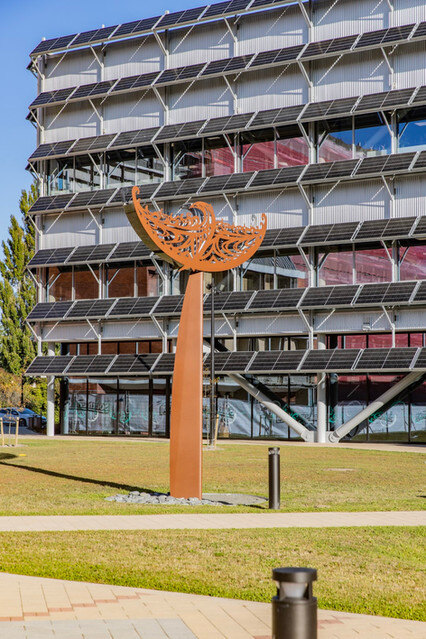
Lincoln University - Christchurch, New Zealand

Base isolation was never going to work for the client economically-speaking. But with memories of the Christchurch Earthquakes still recent, they were open to achieving high levels of resilience whilst staying within their existing budget.  

Beca engineers in Christchurch challenged themselves to find a resilient solution that would cost no more than a conventional system. This led them to Tectonus and a collaborative design process that resulted in a design that met the client's objective.  

The solution featured tension and compression braces with RSFJ dampers, as well as concrete shear walls with Tectonus hold downs. The following results were achieved: 

  • Fully self-centering behaviour
  • Removal of two shearwalls and multiple brace bays
  • Estimated 40% reduction in embodied carbon
  • Winner - World Architectural Festival (Higher Education, '24).
Lincoln building ex Leighs Construction
support placeholder image

How can we help?

Get in touch to ask a question or schedule a free consultation