
%201319%20x%20530%20USE.jpg?width=300&name=AdobeStock_274931064%20(1)%201319%20x%20530%20USE.jpg)
Two recent Oakland retrofit projects demonstrate how friction-based energy dissipation technology now provides a practical and locally accepted pathway to ASCE 41 Tier 3 compliance - while minimizing disruption to existing structures and ongoing operations.
The projects - 1422 Harrison Street and 850 92nd Ave - were both developed using performance-based retrofit strategies incorporating Tectonus energy dissipation systems within existing structural frameworks.
Importantly for California engineers, both projects progressed through local approval pathways including Oakland AHJ review and peer review processes.
Retrofit Constraints Drive Seismic Design Decisions
For many Bay Area retrofit projects, the primary challenge is no longer simply achieving code compliance. The challenge is achieving compliance without triggering disproportionate strengthening scope, extended operational disruption, or major foundation intervention.
This is particularly true for older industrial, warehouse, and adaptive reuse buildings where weak connections, inadequate foundations, and limited structural redundancy can quickly make conventional retrofit schemes uneconomical.
In these cases, use of friction-damping technology can offer an alternative pathway by reducing seismic demand while increasing system ductility and energy dissipation.
Steel truss moment frame structure
At 850 92nd Ave in Oakland, an existing one-storey steel truss moment frame structure presented several common retrofit constraints:
- weak existing connections,
- inadequate foundations,
- and limited tolerance for invasive strengthening works.
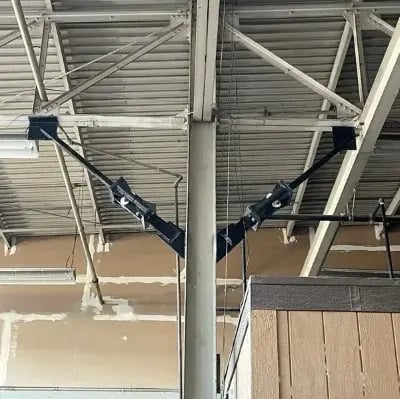 Rather than pursuing extensive conventional strengthening, Tectonus DMAX braces were integrated into the existing roof truss and column system using an ASCE 41-17 Tier 3 nonlinear static procedure.
The retrofit strategy increased system ductility while reducing seismic demand on the surrounding structure and foundations. This significantly minimized foundation work requirements and allowed the retrofit to be integrated within the existing structural geometry.
The project demonstrates how energy dissipation devices can be incorporated into existing steel frame systems using a performance-based retrofit methodology rather than relying solely on force-based strengthening approaches.
Timber Retrofit Applications Are Also Emerging
The same principles were applied differently at 1422 Harrison Street, a timber truss adaptive reuse project in Oakland.
The existing structure (a 1920s office/warehouse conversion with long-span wood trusses) reflects a building typology common throughout the Bay Area. These structures are often difficult to retrofit economically because seismic upgrades can rapidly escalate into major connection and foundation strengthening programs.
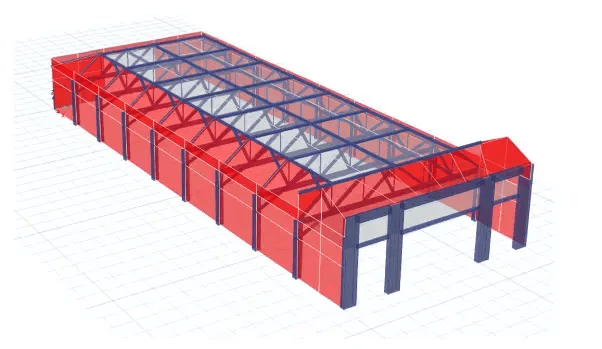
Using Tectonus recentering friction devices, the retrofit team adopted a performance-based design approach under CEBC 2022 and ASCE 41-17 Tier 3 analysis procedures.
Instead of extensive structural replacement, the retrofit strategy focused on:
- increasing ductility,
- reducing seismic demand,
- and strengthening only selected existing truss connections using bolted detailing for rapid installation.
No major foundation strengthening was required.
For engineers working on adaptive reuse and occupancy change projects, this is becoming an increasingly relevant design pathway. The ability to improve global system performance while maintaining constructability within existing structural constraints is often critical to overall project feasibility.
Lower Overstrength Can Significantly Influence Retrofit Scope
One of the key technical advantages of damping-based retrofit systems is the ability to reduce force transfer demands into adjacent structural elements.
Traditional retrofit approaches using BRBs, added shear walls, or heavily stiffened systems can increase demands on collectors, diaphragms, foundations, and existing connections. In retrofit environments, these secondary strengthening requirements frequently drive project cost and complexity.
Tectonus DMAX systems are designed with a low overstrength factor of approximately 1.15, allowing engineers greater flexibility when optimizing retrofit strategies under ASCE 41 procedures.
Combined with highly effective damping and nonlinear performance-based analysis, this can create opportunities to:
- reduce foundation intervention,
- minimize strengthening quantities,
- simplify installation sequencing,
- and preserve more of the existing structure.
These advantages are particularly relevant for occupied buildings, adaptive reuse projects, and industrial facilities where downtime and invasive construction can become major project risks.
Growing Acceptance in California Retrofit Applications
While neither Oakland project required HCAI approval, the underlying Tectonus damping technology has undergone extensive OSHPD/HCAI qualification testing at Lehigh University, including dynamic cyclic testing across multiple device capacities.
For California engineers evaluating alternative seismic retrofit strategies, this testing pedigree provides an additional level of confidence alongside the successful Oakland approval pathways.
As more retrofit projects pursue ASCE 41 Tier 3 and performance-based compliance strategies, damping technologies are increasingly being considered not simply as specialty systems, but as practical tools for solving difficult constructability and cost challenges within existing buildings.
To explore the Oakland projects in more detail:
- View the 1422 Harrison timber retrofit case study: https://www.tectonus.com/projects/1422-harrison-seismic-retrofit
- View the 850 92nd Ave steel retrofit case study: https://www.tectonus.com/92nd-ave-oakland-projects
And if you would like to understand more about how Tectonus might be able to provide seismic resilience for your next project – please reach out to our expert team to help you better understand the options you now have.