
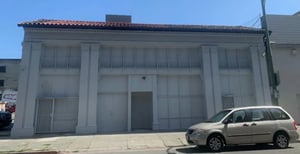
Timber Truss Seismic Retrofit
Project Overview
The project at 1422 Harrison Street in Oakland, California demonstrates a performance-based approach to the seismic retrofit of a timber truss building using friction damping technology.
The existing building is a 1920s single-story reinforced concrete structure with long-span timber roof trusses. The building is being converted from office and warehouse use to an A-2 assembly occupancy for an event space and indoor miniature golf facility, triggering a mandatory seismic upgrade under the California Existing Building Code (CEBC).
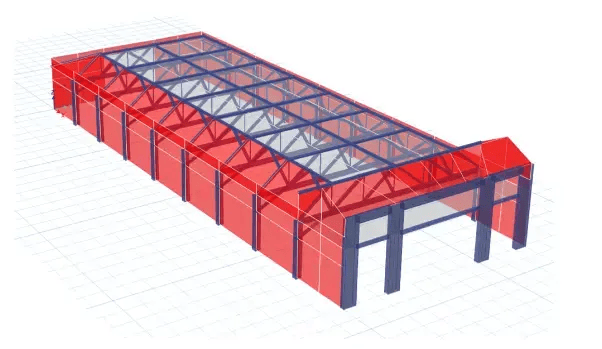
Axonometric view of analysis Model in Etabs Building Design Software.
The retrofit strategy integrates Tectonus Resilient Slip Friction Joint (RSFJ) dampers into timber brace frames connected to the existing roof trusses and wall piers. The dampers act as displacement-dependent energy dissipation devices with self-centering capability, increasing system ductility and reducing seismic demand on the existing structure.
This approach allowed the design team to achieve code compliance while minimizing strengthening of existing structural elements and avoiding major foundation work, which is often the largest cost driver in retrofits of this building type.
Timber Truss Buildings in Seismic Regions
Long-span timber truss buildings from the early 20th century are common throughout the San Francisco Bay Area and many West Coast cities. These structures typically present several seismic vulnerabilities:
- Weak or brittle truss-to-wall connections
- Limited diaphragm strength and stiffness
- Unreinforced masonry or lightly reinforced concrete walls
- Foundations not designed for modern seismic forces
When these buildings undergo occupancy changes to assembly uses, building codes typically require upgrades to meet full seismic performance criteria.
Conventional retrofit solutions often involve:
- New steel braced frames
- Concrete shear walls
- Significant foundation strengthening
These upgrades can be expensive and disruptive, particularly when foundations must be enlarged to resist increased seismic forces. In this project, the design team pursued an alternative strategy: reducing seismic demand by introducing damping and ductility into the structural system.
Seismic Retrofit Strategy
The retrofit combines the existing structure with new timber braces incorporating friction dampers. The lateral force resisting system (LFRS) uses:
Existing structural elements
- Reinforced concrete perimeter walls
- Concrete façade frame
- Masonry and CMU rear walls
- Long-span timber roof trusses
Strengthening and retrofit elements
- Local strengthening of existing truss connections
- Roof diaphragm strengthening with plywood
- Select new wood shear walls
- New CLT mezzanine diaphragm
- Timber brace frames incorporating RSFJ friction dampers
These elements were explicitly included in the nonlinear analysis model.
The friction dampers provide the primary energy dissipation mechanism in the transverse direction of the structure, reducing seismic forces transferred to the existing walls, connections, and foundations.
Friction Damper Bracing System
The retrofit uses Tectonus Resilient Slip Friction Joint (RSFJ) dampers installed within timber braces connected between roof truss nodes and wall piers.
The RSFJ device dissipates energy through controlled sliding friction between steel plates while disc springs provide a restoring force that recenters the system after displacement.
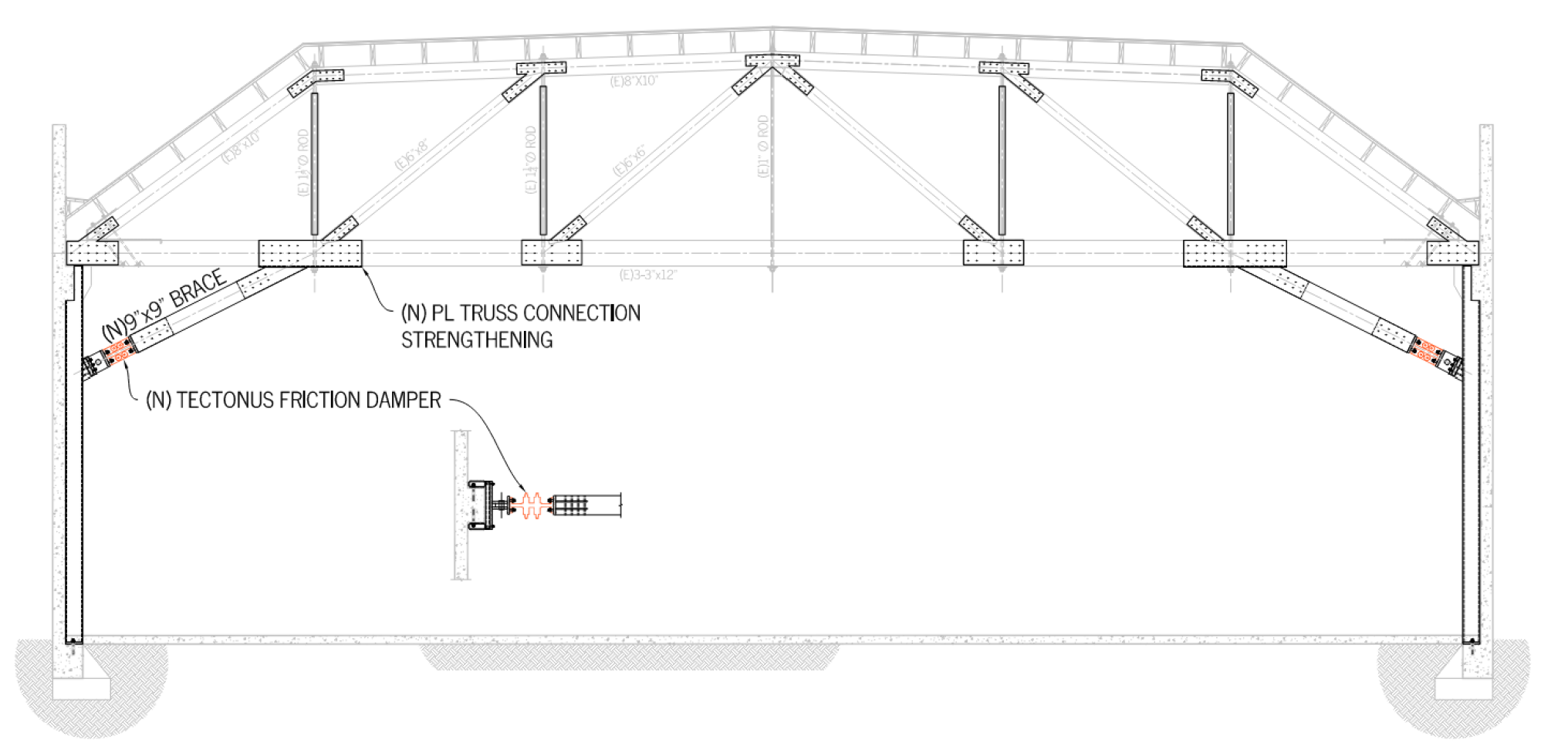
Transverse section showing Tectonus friction damper and truss connection strengthening.
Key characteristics of the device include:
- Stable hysteretic energy dissipation
- Self-centering behavior
- All structural components remain elastic
- No yielding or sacrificial parts
The resulting hysteresis provides supplemental damping while limiting residual drift after earthquakes. Multiple brace configurations were used depending on force demand and geometry.
For example, the retrofit includes brace types with different damper capacities installed between timber braces and existing structural elements.
This configuration allows the dampers to:
- Dissipate seismic energy
- Limit force demand on existing structural components
- Protect brittle elements such as masonry walls and truss connections
Code Compliance Strategy
Because the proposed system includes energy dissipation devices not listed in ASCE 7 prescriptive lateral systems, the design was developed using a performance-based seismic design approach.
The compliance pathway followed the California Existing Building Code (CEBC) 2022.
1. Occupancy and Risk Category
The new assembly occupancy qualifies as:
Risk Category II with an occupant load less than 300.
Under CEBC requirements, the occupancy change triggers a retrofit to meet seismic performance criteria for full seismic forces.
2. Performance-Based Design Pathway
The project used:
CEBC §301.3.3 - Performance-Based Design
and
CEBC §304.3.1(2) - ASCE 41 Tier 3 analysis.
This approach allows the use of alternative structural systems when their performance can be demonstrated through nonlinear analysis.
3. Required Performance Objectives
The building must achieve the following performance levels:
|
Hazard Level |
Performance Objective |
|
BSE-1N |
Life Safety |
|
BSE-2N |
Collapse Prevention |
These objectives ensure the building maintains life safety performance during design earthquakes and avoids collapse under maximum considered events.
4. Nonlinear Seismic Analysis
The retrofit design was evaluated using Nonlinear Response History Analysis (NLRHA) in accordance with ASCE 41-17.
The analytical model was developed in ETABS, with additional analysis performed as required.
5. Structural Modeling
The model included all elements expected to participate in seismic response:
The analysis assumptions followed ASCE 41 requirements:
This approach ensured that existing brittle elements would not experience damaging force demands during seismic events.
6. Ground Motion Hazard Analysis
Rockridge Geotechnical Engineers performed a site-specific ground motion study.
The analysis developed design spectra and ground motion records for both hazard levels:
-
BSE-1N
- BSE-2N
For each hazard level, the analysis used 11 pairs of spectrum-matched ground motions for nonlinear response history analysis.
This provided a statistically robust basis for evaluating structural performance under expected seismic loading.
7. Device Testing Requirements
The friction dampers used in the retrofit must meet ASCE 41-17 requirements for displacement-dependent damping devices.
Testing documentation provided by the manufacturer demonstrates:
- cyclic performance
- displacement capacity
- stability of hysteretic response
Testing requirements follow the provisions of ASCE 41-17 §§15.7–15.8.
8. Independent Peer Review
Because the retrofit relies on:
- performance-based design,
- nonlinear time-history analysis,
- and energy dissipation devices outside prescriptive code systems,
The City of Oakland required an independent structural peer review.
The peer review scope included:
- seismic design criteria
- nonlinear modelling assumptions
- gravity system verification
- device performance assumptions
The peer reviewer was retained directly by the building owner to ensure independence from the design team.
Engineering Outcomes
The introduction of friction dampers enabled a retrofit strategy that:
- Increased global system ductility
- Reduced seismic demand on existing structural elements
- Limited strengthening of existing trusses and connections
- Avoided major foundation upgrades
For timber truss seismic retrofits, reducing force demand can significantly reduce retrofit scope and cost.
Instead of strengthening the entire structure to resist higher seismic forces, damping devices allow engineers to control structural response through energy dissipation.
Project Status
The retrofit design has received permit approval from the City of Oakland.
Construction has not yet commenced.
The project provides a precedent for performance-based seismic retrofit of timber truss buildings using friction dampers in California and other high seismic regions.
Key Takeaways for Structural Engineers
This project demonstrates several lessons relevant to timber truss seismic retrofit projects:
1. Performance-based design enables alternative systems
ASCE 41 Tier 3 analysis allows engineers to use energy dissipation devices not included in prescriptive ASCE 7 systems.
2. Damping can significantly reduce retrofit scope
Introducing damping reduces seismic demand on foundations, walls, and connections.
3. Early coordination with authorities is critical
Jurisdiction approval required clear documentation of the compliance pathway and nonlinear analysis methodology.
4. Nonlinear modelling is essential
Accurate modelling of damper hysteretic behavior and existing structural elements is critical to demonstrating performance.

How can we help?
Get in touch to ask a question or schedule a free consultation
