
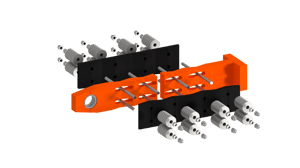
A practical guide for engineers on friction dampers as applied in (seismic) structural engineering, how friction dampers work, where they’re used, and why they matter.
Introduction
In modern structural and mechanical engineering, the ability to control motion and absorb energy is critical. Whether it’s an earthquake, wind load, or machine vibration, excessive movement can cause damage, fatigue, or failure.
A friction damper is one of the simplest yet most effective ways to reduce that motion. It uses the natural resistance between two sliding surfaces (‘friction’) to dissipate energy as heat, protecting structures and equipment from damage.
Friction dampers have become a key technology in seismic design and retrofitting, especially in buildings and bridges, where they’ve been proven to reduce design forces, limit damage and shorten downtime after major earthquakes.
Brief History of Friction Dampers
The concept of using friction for damping motion has a long history. Early mechanical systems relied on friction in clutches, brake-type assemblies and machinery. But its deliberate use in building and structural engineering, especially for seismic protection, began in the late 20th century and evolved over recent decades.
- One of the pioneering devices in structural seismic protection was developed by Pall in the late 1970s and early 1980s. The studies by Pall reported sliding bolted‐joint arrangements that exhibited stable rectangular hysteresis loops under cyclic loading — behaviour suited to earthquake energy dissipation.
- Over the subsequent decades, friction dampers evolved in several directions: enhanced sliding surfaces/coatings, improved bolt-clamp systems (such as Belleville springs), and self-centring variants to reduce residual drift - see Resilient Slip Friction Joint technology - RSFJ.
- More recently, research has refined how to optimise slip loads, height-wise distribution of devices, and modelling of friction devices in both new construction and retrofit scenarios. For example, a 2023 study on friction wall dampers proposed empirical equations for optimal slip load distributions across stories.
- Today, friction dampers are recognised as a mature technology within seismic energy-dissipation devices: simple, robust, and widely employed in new and retrofit constructions around the world.
What began as a clever adaptation of mechanical friction has matured into a reliable element of seismic-resilient design. Understanding its evolution helps engineers appreciate the assumptions, successes and limitations embedded in current practice.
Frequently Asked Questions About Friction Dampers
1. How does a friction damper work?
A friction damper consists of steel plates clamped together by bolts or springs. When forces acting on the structure exceed a preset limit, known as the slip load, the plates begin to slide against each other.
That sliding converts kinetic energy from the structure into heat through friction, similar to the way a car’s brake pads dissipate energy. When shaking stops, the damper stops sliding.
In seismic applications, this controlled slip keeps the main frame from yielding or cracking, making the structure more resilient and easier to repair.
2. What types of friction dampers are used in buildings?
There are three main categories:
- Braced-frame friction dampers – installed where steel braces connect. The Pall Friction Damper, developed in Canada in the 1980s, is the best-known example and has been used in hundreds of buildings worldwide. More recently, the DMAX brace has demonstrated the state of the art by being the first friction damper to meet California’s hospital standards, commonly believed to be the toughest in the world.
- Sliding Hinge Joints (SHJ) – placed at beam-to-column connections, typically in Moment Resisting Frames allow controlled rotation during seismic motion, reducing stress on welds.
- Resilient Slip Friction Joints (RSFJ) – combine friction plates with re-centring springs, so that after sliding, the structure returns to its original alignment with minimal residual drift. They are commonly applied as braces or as shear wall hold downs.
Each type serves the same purpose — to dissipate energy — but their differences lend themselves to different performance objectives or to different parts of a structural system.
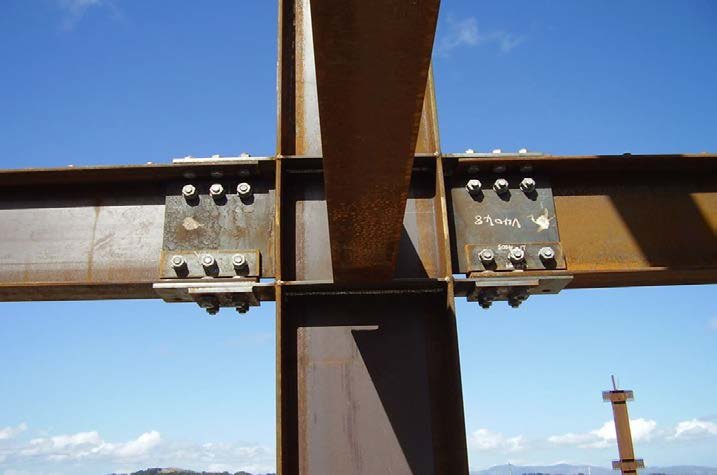 A Sliding Hinge Joint (SHJ) installed in a MRF at Te Puni Student Village in New Zealand. Photo courtesy of Charles Clifton.
3. Why use friction dampers instead of other damping systems?
Engineers are likely to choose friction dampers because they are:
- Simple and robust — mostly metal parts, no fluids or electronics.
- Cost-effective — cheaper than viscous dampers, comparable with Buckling Restrained Braces (BRBs).
- Low maintenance — few moving parts to wear out.
- Temperature-insensitive — unlike fluid dampers, friction devices perform consistently in both hot and cold conditions.
- No yielding — unlike conventional systems or BRBs, there are no yielding parts.
For many projects, friction dampers provide a very competitive cost-to-performance ratio when compared to other passive energy dissipation devices.
4. Where are friction dampers installed in structures?
Friction dampers can be installed wherever relative movement occurs during loading. Common locations include:
- At the intersection of diagonal or chevron braces
- Inside beam-column connections
- Along bracing links or toggle mechanisms that amplify movement
- As hold downs in rocking wall systems.
Placement is typically chosen to maximize the amount of energy dissipated while keeping structural deformation within safe limits.
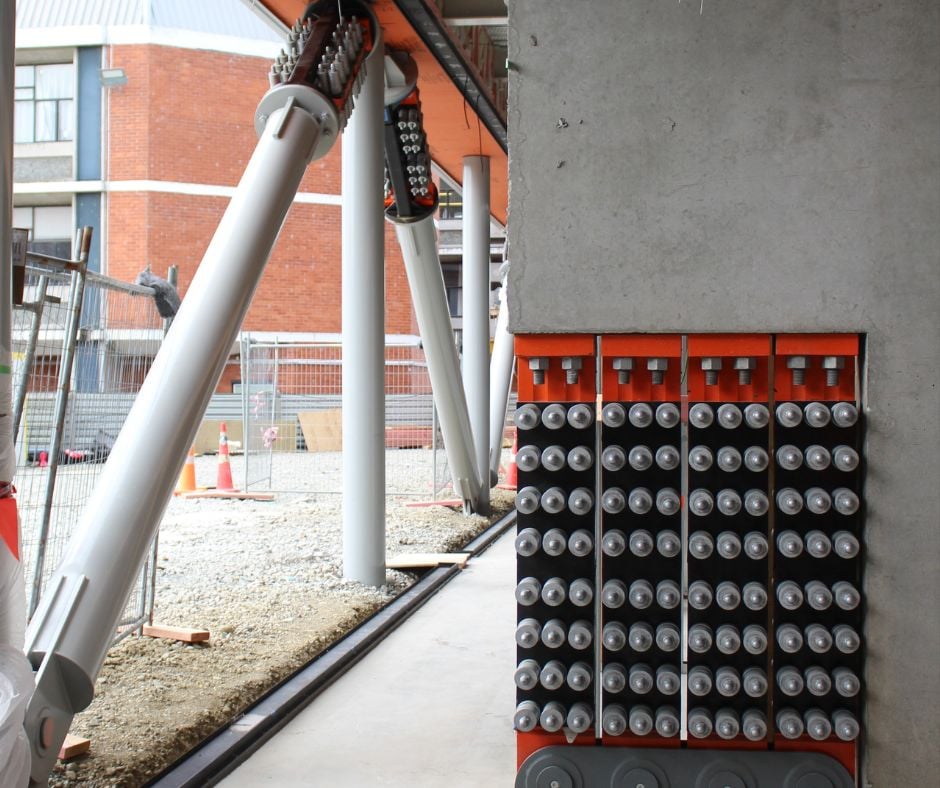
Friction dampers installed as both diagonal braces and shear wall hold downs on a university building project in New Zealand.
5. How are friction dampers designed and modelled?
The design starts with selecting the target slip load i.e. the force level at which the damper begins to slide. Engineers choose this value so the damper activates during earthquakes but remains rigid during normal service (in countries where the seismic code has a Serviceability Limit State, such as in New Zealand or Canada, this can be a useful feature to optimise performance).
In computer models (ETABS, SAP2000, OpenSees), friction dampers are represented as nonlinear elements with a rectangular hysteresis loop — meaning constant resistance during sliding. For more advanced systems like the RSFJ, engineers use a flag-shaped hysteresis model that includes both friction and re-centring springs.
6. How reliable are friction dampers over time?
Modern friction dampers are designed for long-term stability. The sliding surfaces use materials like friction pads, brass, or specialized coatings that resist wear.
To keep the slip load consistent, bolts may be preloaded using disc springs that are intended to maintain clamping force even under temperature changes and repeated cycles.
Engineers specifying friction dampers should request longitudinal testing from the supplier to observe any degradation of performance over time.
7. What do building codes say about friction dampers?
In the United States, friction dampers are referred to as 'energy dissipation devices' in codes such as:
- ASCE 7 (for new structures)
- ASCE 41 (for seismic retrofit of existing structures)
- FEMA P-2208, provides modelling and analysis guidance for nonlinear devices in retrofit design
While the codes don’t prescribe exact damper designs, they require that each system be dynamically tested, modelled, and verified to perform as intended under seismic loads. Dynamic testing is critical, since some friction dampers have demonstrated different performance at different velocities.
8. How effective are friction dampers during earthquakes?
Friction dampers have shown reliable performance in real-world events and laboratory tests:
- They reduce peak storey drifts (side-to-side motion).
- They limit structural damage by absorbing energy in the damper instead of the frame.
- When combined with re-centring systems (like RSFJ), they minimize residual drift, allowing rapid re-occupancy after earthquakes.
Buildings in New Zealand, Canada, Japan, and the U.S. using friction dampers have performed exceptionally well during major seismic events.
9. What are some limitations with friction dampers?
While reliable, friction dampers have been associated with some limitations:
- They can lose bolt preload over time if not properly detailed.
- Surface wear or contamination can alter the friction coefficient.
- Performance depends on correct installation - similar to any structural device.
- They don’t provide damping at very low vibrations (unlike viscous devices)
- They may demonstrate velocity dependency.
Proper design, testing, and maintenance address most of these concerns.
10. Can friction dampers be used outside earthquake engineering?
Yes. While they’re best known for seismic protection, friction dampers are also used in:
- Bridges to limit movement under wind or traffic loads
- Industrial equipment to control vibration
- Mechanical systems where adjustable friction resistance is needed
Their simple design and predictable response make them versatile for any situation involving dynamic motion control.
Key Takeaways
- Friction dampers convert sliding motion into heat, reducing vibration and protecting structures.
- They are simple, cost-effective, and reliable, making them a popular choice for both new buildings and retrofits.
- They can be used to reduce seismic demand by adding controlled damping and ductility, thereby creating a value engineering opportunity.
- When combined with re-centring features, they enable low-damage, quickly recoverable designs after earthquakes.
- Modern codes recognize friction dampers as validated energy dissipation systems, provided they’re properly tested and modelled.
Interested to learn more?
There is a wealth of information available on Tectonus' website. In recent years, Tectonus has become synonymous with state-of-the-art performance when it comes to friction dampers. Our team of experts is more than happy to provide 'lunch and learn' sessions and technical presentations for those want to know more. To arrange a time, please get in touch.